Project: FLIF
https://github.com/FLIF-hub/FLIF
“
FLIF is a lossless image format based on MANIAC compression. MANIAC (Meta-Adaptive Near-zero Integer Arithmetic Coding) is a variant of CABAC (context-adaptive binary arithmetic coding), where the contexts are nodes of decision trees which are dynamically learned at encode time.
FLIF outperforms PNG, FFV1, lossless WebP, lossless BPG and lossless JPEG2000 in terms of compression ratio.
Moreover, FLIF supports a form of progressive interlacing (essentially a generalization/improvement of PNG’s Adam7) which means that any prefix (e.g. partial download) of a compressed file can be used as a reasonable lossy encoding of the entire image.
For more information on FLIF, visit https://flif.info
“
To profile the project, I decided to write a script to store the run time.
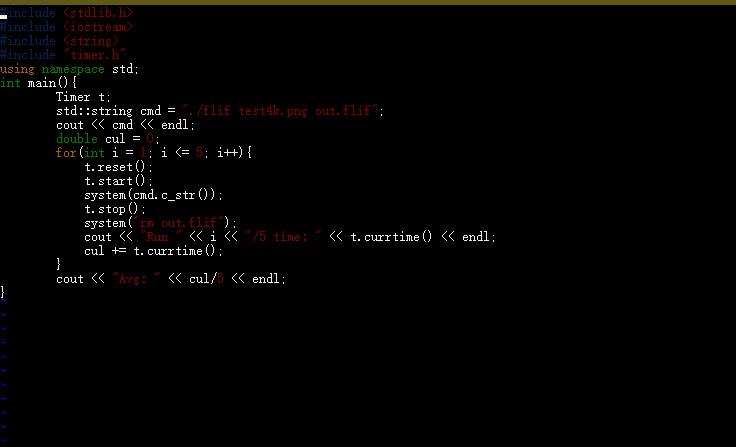
I used Linux system calls record the run time of the program. To control the variables that may affect the run time and to get a more accurate time, I run the program 5 times and get the average run time of the 5 as the run time of the program.
To build a benchmark test case that is able to take 4 minutes, I created a 4k, 8k, and 16k picture as the test samples.
The result of 8k image on Xerxes server:
./flif test8k.png out.flif
Run 1/5 time: 112.959
Run 2/5 time: 113.265
Run 3/5 time: 113.794
Run 4/5 time: 112.956
Run 5/5 time: 113.011
Avg: 113.197
Then I need to run the test using the sample that I created on different optimization level. Therefore, fixing the test script is needed.
First, I created 4 different Makefile to allow my script to build the program with different optimization level:
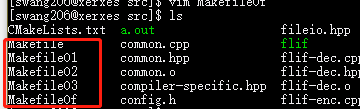
Then in my script, after every test case, I just clean and compile it again, then run the test case.
To test the script, I selected a small image as a sample.
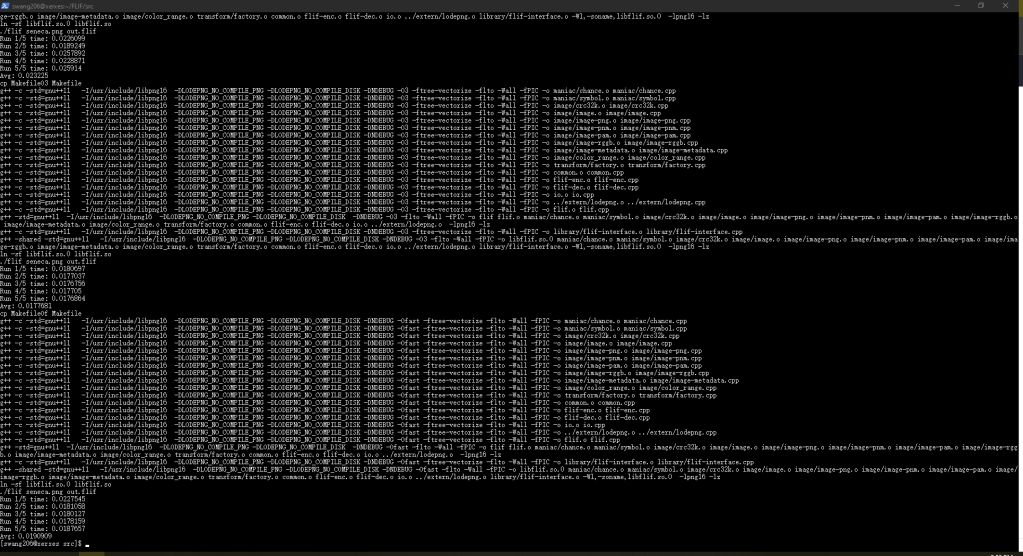
Seems like it works well. Then I just need to modify the script to keep only the output that I need – the times and some other critical information.
The script code is:
#include <stdlib.h>
#include <iostream>
#include <string>
#include "timer.h"
using namespace std;
int main(){
	Timer t;
	system("make clean > /dev/null"); //useless output
	std::string cmd = "./flif seneca.png out.flif";
	int c = 0;
test:
	string builds[4] = {string("cp MakefileO1 Makefile"), string("cp MakefileO2 Makefile"), string("cp MakefileO3 Makefile"), string("cp MakefileOf Makefile")};
	cout << builds[c] << endl;
	system((string(builds[c]) + string(" > /dev/null")).c_str()); //useless output
	system("make all >> buildinfo.txt");//record the build info into a file to log the building procedure
	cout << cmd << endl;
	double cul = 0;
	for(int i = 1; i <= 5; i++){
            t.reset();
	    t.start();
	    system(cmd.c_str());
	    t.stop();
	    system("rm out.flif");
	    cout << "Run " << i << "/5 time: " << t.currtime() << endl;
	    cul += t.currtime();
	}
	cout << "Avg: " << cul/5 << endl;
	system("make clean > /dev/null"); //useless output
	c++;
	if(c != 4) goto test;
}
output:
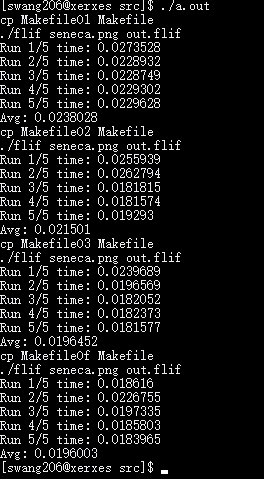
Finally, I just need to use the correct sample image and redirect the output into a file, then I can do others staff.
./swtest.out > 8k_result.txtThis blog will be updated when I get the result on both Xerxes server(x86) and Israel(AArch86).
Result on Xerxes(8K Image):
O1:
Run 1/5 time: 136.447
Run 2/5 time: 136.021
Run 3/5 time: 136.356
Run 4/5 time: 136.181
Run 5/5 time: 136.28
Avg: 136.257
O2:
Run 1/5 time: 113.303
Run 2/5 time: 113.05
Run 3/5 time: 113.058
Run 4/5 time: 113.007
Run 5/5 time: 113.434
Avg: 113.17
O3:
Run 1/5 time: 115.2
Run 2/5 time: 115.248
Run 3/5 time: 115.254
Run 4/5 time: 115.537
Run 5/5 time: 115.56
Ofast
Run 1/5 time: 114.524
Run 2/5 time: 114.434
Run 3/5 time: 114.959
Run 4/5 time: 114.584
Run 5/5 time: 114.871
Avg: 114.675
Result on Israel:
O1:
Run 1/5 time: 480.112
Run 2/5 time: 482.835
Run 3/5 time: 487.211
Run 4/5 time: 481.755
Run 5/5 time: 486.157
Avg: 483.614
O2:
Run 1/5 time: 342.601
Run 2/5 time: 343.368
Run 3/5 time: 343.536
Run 4/5 time: 343.573
Run 5/5 time: 350.155
Avg: 344.647
O3:
Run 1/5 time: 354.89
Run 2/5 time: 358.898
Run 3/5 time: 359.501
Run 4/5 time: 354.217
Run 5/5 time: 349.274
Avg: 355.356
Ofast:
Run 1/5 time: 351.706
Run 2/5 time: 350.837
Run 3/5 time: 345.919
Run 4/5 time: 350.003
Run 5/5 time: 346.357
Avg: 348.964
According to the result, the optimization level affects the runtime of the program.
Usually, the O3 is the fastest optimization level, but in this testing case, the O2 and O3 does not have big differences.
 Shichao's SPO600